Music Infographic Template Elements: A Strategic Resource for Educators, Creators, and Professionals
When you need to explain a chord progression, visualize a scale pattern, or communicate the structure of a musical form, text alone rarely does justice. The Music Infographic Template Elements offer a structured, visually coherent way to bridge the gap between abstract musical concepts and clear understanding. This template, provided in AI CS6 and EPS10 formats with an included image reference, is not merely a graphic file—it is a practical framework for anyone who needs to present music-related information with precision, clarity, and impact.
For educators, the value is immediate: a well-designed infographic can replace pages of notes and reduce the cognitive load on students. For marketers, creators, and small business owners working in music education, software, or instrument sales, the template becomes a communication asset that supports positioning, brand consistency, and customer understanding. The question is not whether infographics help—they do—but how to use this specific set of elements with intention rather than decoration.
What the Music Infographic Template Elements Actually Provide
At its core, this template includes illustrative components designed to represent music theory, instrument anatomy, practice techniques, and harmonic structures. The file is built in Adobe Illustrator with CMYK color support and vector scalability, meaning you can resize, recolor, and recombine elements without degradation. The included image file gives you a reference layout, but the real strategic value lies in the modularity of the components.
Rather than starting from a blank canvas, you gain access to pre-built visual vocabulary: notation symbols, instrument silhouettes, rhythm patterns, flow arrows, labeled diagrams, and color-coded sections. These are not arbitrary designs—they follow common pedagogical conventions that learners already recognize. When you use these elements, you reduce friction between the information and the audience.
For a music teacher preparing lesson handouts, this means less time drawing staves and more time refining the lesson sequence. For a content creator building an online course, it means consistent visual language across modules. For a publisher developing instructional books, it means production-ready assets that align with industry expectations.
Strategic Applications Across Goals and Audiences
The versatility of the Music Infographic Template Elements becomes apparent when you map them to specific objectives. Consider three distinct use cases:
In education and training: A guitar instructor developing a curriculum on the circle of fifths can use the template to create a single-page reference that students keep in their binders. The visual hierarchy—key signatures on the outer ring, related minor keys on the inner ring, color-coded by tonality—helps learners see relationships that text alone obscures. Over a semester, this one asset reduces repetition and reinforces recall.
In marketing and content creation: A small business selling beginner ukuleles can produce an infographic comparing body shapes, wood types, and tonal characteristics. The template elements allow you to create a side-by-side visual that customers can scan in seconds. When shared on social media or embedded in a product page, this asset supports decision-making and reduces return rates caused by mismatched expectations.
In internal operations and team communication: A music school coordinator designing a practice roadmap for faculty can use the template to outline weekly milestones, technique checkpoints, and repertoire requirements. The clarity of the visual format reduces misunderstandings between teachers and helps standardize instruction across multiple locations.
Each of these applications shares a common thread: the template is not the end product but the medium for clearer thinking and faster comprehension.
Planning Your Approach: Intentional Use Versus Random Decoration
The most common mistake professionals make with infographic templates is treating them as fill-in-the-blank exercises. You drop in some text, apply a color scheme, and call it done. The result is visually busy but conceptually hollow. To avoid this, approach the Music Infographic Template Elements as a planning tool first and a design asset second.
Start by defining the single question your infographic must answer. For example: “What is the correct finger placement for a C major scale on piano?” or “What are the four stages of a practice session?” Write that question at the top of your working document. Then select only the template elements that directly support that answer. If you find yourself adding decorative notes, extra instrument icons, or unnecessary diagrams, pause and reassess.
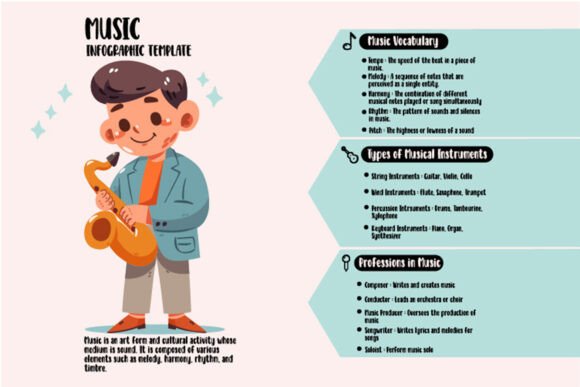
A useful planning technique is to sketch a rough layout on paper or in a simple wireframe before opening the AI file. Identify where the eye should land first, what secondary information supports it, and what can be omitted. The included image in the template gives you one layout option, but the modular nature of the elements allows you to rearrange them for your specific goal.
Consider also the delivery medium. A printed handout for a classroom may benefit from larger text and more white space. A social media graphic may require a tighter crop and bolder contrast. An e-book illustration may need consistent styling across dozens of pages. The vector format of AI CS6 and EPS10 files lets you adapt the same base elements to each context without rebuilding from scratch.
Integration with Branding and Long-Term Consistency
For organizations and professionals who produce music-related content regularly, the template elements become a foundational asset for brand consistency. By establishing a style guide that includes the color palette, typography, and icon treatment from the template, you ensure that every infographic—whether for beginner theory or advanced composition—feels like part of a coherent system.
This matters more than most people realize. When a student or customer sees multiple materials that share visual language, they subconsciously attribute higher credibility to the source. Consistency signals professionalism and attention to detail. Over time, this builds trust and reduces the mental effort required to parse each new piece of content.
To operationalize this, create a simple asset library from the template: export individual elements as PNG or SVG files with descriptive filenames (e.g., “treble-clef-blue.svg,” “piano-keyboard-2-octaves.ai”). Store them in a shared drive or creative cloud folder. When a team member needs to create a new handout or social post, they pull from this library instead of reinventing the visual language each time.
Risks and Considerations Before Relying on the Template
No template is a substitute for thoughtful content. If your underlying material is inaccurate, poorly structured, or irrelevant to your audience, no amount of visual refinement will salvage it. The Music Infographic Template Elements amplify clarity—they do not create it. Before you invest time in layout and design, validate that your information is correct, your sequence is logical, and your goal is well-defined.
Another risk is over-reliance on the included layout. The reference image provided with the template shows one way to organize the elements, but your audience and context may call for a different approach. Copying the example exactly can lead to an infographic that feels generic or mismatched. Treat the reference as inspiration, not prescription.
Additionally, consider the learning curve. If you or your team are not comfortable with Adobe Illustrator, vector editing, or layer management, the AI CS6 and EPS10 files may feel intimidating. Budget time for a brief tutorial or practice session before you need to produce something under deadline. The template is only useful if you can manipulate it efficiently.
There is also the question of file compatibility. AI CS6 is a mature format, but newer versions of Illustrator may handle it differently. If your workflow involves multiple software tools, verify that the EPS10 fallback works for your import pipeline. Testing this early prevents last-minute surprises.
Decision-Making Guidance: When to Use and When to Skip
The Music Infographic Template Elements are best suited for situations where visual structure directly supports comprehension. Use them when you need to show relationships—such as intervals on a staff, practice progression over time, or component parts of an instrument. Use them when your audience includes visual learners or when the information density is high enough that a block of text would overwhelm.
Skip the template when the information is purely linear, when the audience already has strong domain knowledge, or when the medium does not support graphics (such as a plain-text email or an audio-only podcast). Also skip it when the goal is emotional storytelling rather than instructional clarity—a photograph or illustration may serve better than a structured diagram.
For entrepreneurs and small business owners, a good rule of thumb is to create one high-quality infographic for each core concept you teach repeatedly. That asset becomes a permanent part of your content library. Over months and years, the cumulative return on the initial design effort is substantial.
Practical Criteria for Deciding
- Concept complexity: Does the idea benefit from a diagram? If yes, proceed.
- Audience familiarity: Are they beginners or intermediates needing scaffolding? If yes, proceed.
- Repeat usage: Will you reference this visual more than three times in a year? If yes, invest the time.
- Production capacity: Do you have the software skills and time to customize the template properly? If not, consider a simpler format.
Long-Term Value and Strategic Positioning
Professionals who adopt the Music Infographic Template Elements with a clear strategy gain more than a single handout or post. They build a visual communication system that enhances teaching, marketing, and operational clarity over time. The template, used intentionally, becomes a multiplier for your expertise—it lets you present complex musical ideas more quickly, more accurately, and more persuasively than text alone allows.
For educators, this translates to better student outcomes and fewer repeated explanations. For marketers and creators, it means higher engagement and clearer differentiation. For publishers and curriculum developers, it means production efficiency and brand coherence across a growing library of materials.
The key is to treat the template as a starting point for strategic visual thinking, not a shortcut to finished content. When you combine accurate information, thoughtful sequencing, and consistent design, the infographic becomes a tool that serves both you and your audience. That alignment is what makes the difference between a graphic that is merely looked at and one that is truly understood.