Excel Habit Tracker Template: Build Better Routines
Building consistent habits is the quiet engine behind most meaningful progress. Whether you are launching a side project, growing a small business, or simply trying to bring more structure to your day, the gap between intention and action often comes down to one thing: a system that works for you. The Habit Tracker Template I Excel offers exactly that—a straightforward, visual way to track up to 45 habits per month across daily, weekly, and monthly cadences. It is not a complicated app with a steep learning curve. It is a spreadsheet that meets you where you are, ready to adapt to your goals, your rhythm, and your life.
What makes this template genuinely useful is how it balances flexibility with clarity. You do not need to commit to a rigid system that forces you to track the same five habits every day. Instead, you can add up to 15 custom habits for each time frame—daily, weekly, and monthly—and see your progress across four built-in graphs. This article explores how different users can put this template to work, creative ways to adapt it, and practical tips to keep your tracking clear, effective, and sustainable.
What the Habit Tracker Template I Excel Offers
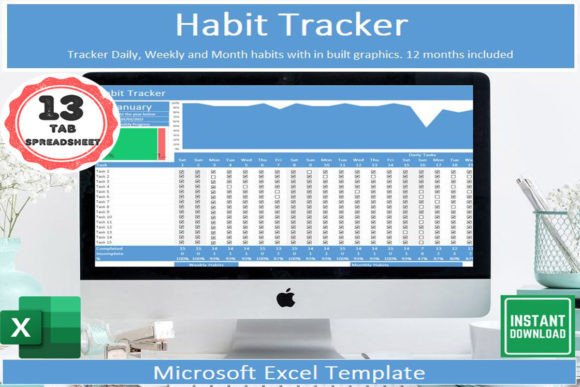
At its core, this is a downloadable Excel spreadsheet with a tab for each month (13 tabs total, including instructions). Each month’s tab has sections for daily, weekly, and monthly habits. You can list up to 15 habits per section, giving you the ability to track a wide variety of behaviors without overwhelming the layout. As you tick off completed habits, the template automatically updates four different graphs per month, helping you see patterns and progress at a glance.
Because the template works with the free Microsoft Excel app on mobile devices, you can update it on the go. That means you are not tethered to a desktop computer. You can check off a morning habit while waiting for coffee, review your weekly goals during a commute, or reflect on monthly trends during a quiet evening. The digital download means you own the file—no subscription, no internet required after the initial download.
- Custom up to 45 habits per month (15 daily, 15 weekly, 15 monthly)
- Four progress graphs per month for visual feedback
- 13 monthly tabs plus an instructions tab
- Mobile-friendly via the free Excel app
- One-time download with no recurring fees
This combination of capacity, visualization, and portability makes it a practical tool for anyone who wants to move beyond vague intentions and into consistent action.
Why Visual Progress Matters for Habit Tracking
Tracking a habit on paper or in a simple list can work, but seeing that data transformed into a graph adds a layer of feedback that is hard to replicate. The Habit Tracker Template I Excel includes four graphs for each month, so you are not just collecting checkmarks—you are looking at trends. You might notice that your weekly habits are more consistent than daily ones, or that a particular month shows a dip in activity and you can ask yourself why.
Graphs turn abstract numbers into a story. When you see a line moving upward or a bar chart showing a full week of green checks, it reinforces your effort. This visual reinforcement can be especially powerful during weeks when motivation flickers. Instead of relying on willpower alone, you let the data remind you of what you have already built.
Creative Applications for the Template
The template’s structure is simple, but the ways you can use it are wide open. Here are several approaches tailored to different goals and audiences.
For Creative Professionals and Freelancers
If you are a designer, writer, or marketer, your work often involves a mix of daily output, weekly planning, and monthly reflection. You might use the daily section to track tasks like “write 500 words,” “review portfolio,” or “send three pitches.” The weekly section could hold broader habits such as “update social media schedule” or “research one new tool.” Monthly habits might include “publish one case study” or “attend a networking event.”
The graphs become especially useful here. You can see if your daily creative output correlates with weekly preparation or if your monthly goals need adjustment based on real performance. The template turns your habits into a feedback loop, helping you refine your process over time.
For Small Business Owners and Entrepreneurs
Running a business means balancing multiple responsibilities that operate on different time scales. Daily habits might include “check financial transactions” or “respond to customer inquiries.” Weekly habits could involve “review marketing analytics” or “plan content calendar.” Monthly habits might cover “update budget” or “evaluate supplier performance.”
With the template, you are not just tracking—you are building a dashboard of operational consistency. The graphs help you spot months where business habits slipped, so you can investigate what happened and adjust. Over time, this pattern recognition becomes a strategic advantage.
For Hobbyists and Lifelong Learners
Not every habit needs to be work-related. You might want to track reading, practicing an instrument, learning a language, or exercising. The daily section could hold “practice 20 minutes,” “read one chapter,” or “study 15 vocabulary words.” Weekly habits might include “complete one lesson” or “review progress.” Monthly habits could be “finish one book” or “record a practice session.”
The beauty of this setup is that it respects different rhythms. Some habits thrive on daily repetition, while others make more sense weekly or monthly. By separating them, you avoid the pressure to do everything every day, which often leads to burnout.
For Educators and Coaches
If you teach or mentor others, you can use the template as a model for your students or clients. You might customize it to reflect their specific goals—academic habits, wellness routines, or professional development. The visual graphs give them a tangible way to see their own progress, which can be highly motivating. You can also use it personally to track your own teaching habits, such as “plan one lesson,” “provide feedback,” or “connect with each student.”
Adapting the Template for Different Contexts
The Habit Tracker Template I Excel is designed to be edited, so you are free to rename sections, adjust categories, or change the habit names to match your context. Here are a few ways to adapt it based on audience and medium.
For Personal Development
Use the daily section for habits like “meditate 10 minutes,” “drink 8 glasses of water,” or “walk 6,000 steps.” Weekly habits could include “review goals,” “plan meals,” or “schedule downtime.” Monthly habits might cover “reflect on learning,” “adjust priorities,” or “try something new.” The graphs will show you which habits stick and which ones need a different approach.
For Team or Group Use
If you coordinate a small team, you could share the template (with separate tabs for each member) or use it as a shared file where everyone tracks their own habits. This works well for collaborative projects where certain behaviors need to be consistent across the group, such as “daily stand-up,” “weekly update,” or “monthly review.”
For Hybrid Work or Remote Roles
Remote workers often struggle with separating work and personal habits. The template can help you track healthy boundaries. Daily habits might include “start work at set time,” “take a real lunch break,” and “log off by 6 PM.” Weekly habits could involve “review task list” or “connect with one colleague.” Monthly habits might be “evaluate work-life balance” or “update professional goals.”
How to Keep Your Tracking Clear and Effective
Even the best template is only as useful as the habits you put into it. Here are practical recommendations to keep your tracking organized and meaningful.
- Start small. It can be tempting to fill all 15 slots in each section immediately, but beginning with three to five habits per section gives you room to build momentum.
- Choose habits that are specific and measurable. Instead of “exercise more,” use “30-minute workout” or “walk 5,000 steps.” Specificity makes checking off easier and more satisfying.
- Review your graphs monthly. The four graphs are there for a reason. Look at them before you start a new month. Ask yourself what worked and what did not.
- Adjust without guilt. If a habit is not serving you, remove it or replace it. The template is a tool, not a test. Flexibility is a feature, not a failure.
- Use the mobile app for real-time tracking. The free Excel app lets you update habits in the moment, which improves accuracy and reduces the chance of forgetting.
Practical Examples of Monthly Setup
Imagine it is the start of a new month. You open the template, go to the corresponding tab, and list your habits. In the daily section, you might write: “morning pages,” “30-minute walk,” “no phone after 9 PM,” “drink 2 liters of water,” and “read 20 pages.” For the weekly section: “plan meals,” “review budget,” “call one friend,” “write newsletter,” and “deep clean one area.” For monthly: “finish one book,” “update portfolio,” “attend workshop,” “review yearly goals,” and “schedule doctor appointment.”
As the month progresses, you check off daily habits each evening, weekly habits on a chosen day (Sunday evening, perhaps), and monthly habits whenever they are accomplished. At month’s end, the graphs show you where your consistency was strongest and where it dipped. You use that information to set up the next month, perhaps swapping out a habit that did not take hold or increasing the frequency of one that worked well.
Recommendations for Long-Term Use
Consistency with the template itself is key. The first month might feel novel, but by month three, the habit of tracking can become as automatic as the habits you are tracking. To keep it sustainable, audit your habits every quarter. Remove what no longer aligns, add what does, and let the graphs guide your decisions.
If you share your progress with an accountability partner or a coach, the template serves as a clear record. You can show them your month’s graphs and discuss what you learned. This external perspective often reveals blind spots you might miss on your own.
The Habit Tracker Template I Excel is not a magic solution—it is a structured container for your intentions. What you put into it and how you use the feedback it provides will determine the results. For anyone looking to move from wanting to change to actually changing, this template offers a practical, visual, and flexible starting point.