Music Collection Tracker Library
Managing a music collection that spans decades, formats, and genres presents a distinct challenge: how do you maintain clarity about what you own, what you have listened to recently, and where the gaps in your library actually are? The Music Collection Tracker Library, built as a Google Sheets template for vinyl, tape, CD, and digital formats, offers a structured approach to this problem. Rather than relying on memory, sticky notes, or fragmented lists, this tool provides a single source of truth for your collection. For anyone who treats their library not just as a hobby but as a resource for creativity, branding, or reference, this kind of systematic tracking shifts the experience from passive accumulation to active curation.
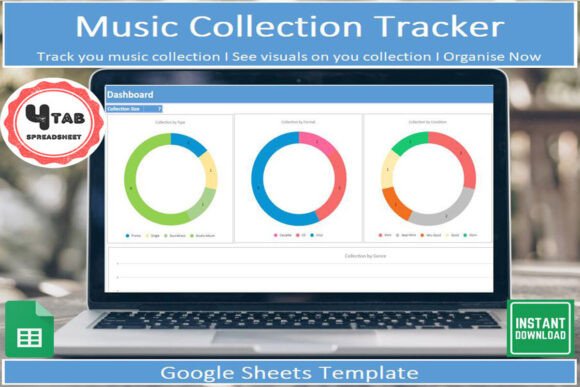
The template includes a dashboard with visual insights, drop-down menus for rapid categorization, and the ability to filter, sort, and search across your entire library. When you download the PDF containing the link and instructions, you gain access to a pre-laid-out structure that captures the main details of each item. Add the details, and the dashboard automatically updates. Because it runs on Google Sheets, you can use it on any device after downloading the free Google Sheets app. This means your collection data travels with you whether you are at a record fair, a used bookstore, or discussing a reference track with a collaborator.
Why a Structured Collection Library Supports Better Decisions
Tracking a music collection is rarely an end in itself. For entrepreneurs, creators, and professionals, a music library often underpins creative work, brand identity, or educational content. A podcaster needs to know which tracks they have licensed and used. A video producer needs to quickly locate a specific pressing of a track for a project. A small business owner curating in-store playlists wants to avoid repetition and ensure variety across shifts. Without a structured tracker, these decisions rely on memory or manual searching through shelves and digital folders.
The Music Collection Tracker Template reduces that cognitive load. By entering details consistently, you create a searchable index that answers questions in seconds: “Which version of this album do I own?” “Have I already cataloged that 7-inch single?” “How many releases from this label are in my library?” The dashboard provides visual insights that reveal patterns in your collection, such as the distribution across formats, decades, or genres. These patterns inform future purchasing decisions. If you notice that your collection skews heavily toward one genre, you can deliberately explore others. If you see that you own many compilations but few studio albums from a key artist, you have a clear direction for your next additions.
This level of intentionality is what separates a random accumulation from a thoughtfully developed library. The tracker does not make the decisions for you, but it surfaces the data you need to make better choices aligned with your goals, whether those goals are creative, professional, or personal.
Practical Use Cases for the Music Collection Tracker
Understanding when and how to use this template matters more than the template itself. Consider the following scenarios where a structured library tracker becomes strategically useful:
Creative Reference and Sampling
If you produce music, compose for media, or sample from physical media, knowing exactly what you own and where it is located saves time and preserves creative flow. Instead of flipping through dozens of records to find a specific drum break or ambient texture, you can filter your collection by genre, tempo, or instrumentation if you have captured that data. The drop-down lists in the template speed up data entry, so you can catalog a newly acquired record in under a minute. Over time, your library becomes a curated palette for creative work.
Inventory for Resale or Insurance
Collectors who sell records, tapes, or CDs need accurate inventory records. A tracker that includes condition notes, purchase price, and estimated value helps you make informed pricing decisions. It also provides documentation for insurance purposes. If you ever need to file a claim after damage or theft, having a detailed, exportable list of your collection is invaluable. The Google Sheets format allows you to share or export the data easily.
Content Creation and Curation
Bloggers, playlist curators, and educators who write about music need to reference specific releases accurately. A tracker ensures you do not misidentify a pressing year, label, or track listing. When you write about an album, you can verify details from your own copy rather than relying on third-party databases that may contain errors. Over time, this builds credibility with your audience.
Long-Term Collection Planning
A collection that grows over decades can become unwieldy without some form of planning. The dashboard insights reveal trends. You might discover that you own 400 CDs, 200 LPs, and 50 cassettes. Perhaps you have no 7-inch singles at all, or you have dozens from a specific era. These observations help you set boundaries: maybe you decide to focus on completing a particular label’s catalog, or you choose to diversify formats. The tracker makes these discussions with yourself concrete.
How to Approach the Template with Clear Intentions
Before entering data, consider what you want from the tracker. Do you need it primarily for creative reference, for insurance documentation, for resale management, or for general organization? Your goal determines which fields you prioritize. If resale matters most, condition and purchase price fields become essential. If creative reference is your focus, add custom tags for mood, instrumentation, or BPM. The template offers a solid foundation, but you can extend it by adding columns that match your specific context.
Start by cataloging a small batch of items, perhaps 20 to 50. This lets you test the workflow and decide whether you want to adjust any categories or drop-down options. Then commit to a regular cadence. Some users add items as soon as they acquire them. Others schedule a weekly cataloging session. Consistency prevents backlogs that feel overwhelming. The template is designed for incremental updates, so there is no pressure to complete everything in one sitting.
The filter, sort, and search functions become more valuable as your collection grows. A collection of 500 items can be navigated quickly if each entry includes consistent data. If you skip fields or use inconsistent naming, those functions lose reliability. Invest a few extra seconds per entry to maintain quality. For example, instead of typing “rock” in one entry and “rock / alternative” in another, decide on a controlled vocabulary and stick to it. The drop-down lists in the template help enforce consistency, but you can customize them to reflect your collection’s actual categories.
What to Consider Before Relying on a Digital Tracker
No tool is risk-free. The primary risk of using a digital tracker without clear goals is that it becomes a data graveyard. You spend hours entering information, but you never revisit it. The dashboard remains unexamined, and the collection continues to grow without intentionality. To avoid this, set a monthly or quarterly review of your dashboard. Look at the visual insights and ask yourself whether your collection is moving in the direction you want. If you notice that your library is dominated by a single format or genre, decide whether that aligns with your broader interests or professional needs.
Another risk is over-reliance on the tracker at the expense of the physical experience. The purpose of tracking is to enhance your relationship with your collection, not to replace it. If you find yourself spending more time updating cells than listening to music, reassess your workflow. The template should serve your engagement with music, not compete with it.
Data entry fatigue is real. If you attempt to catalog a large collection all at once, you may burn out and abandon the tracker entirely. Spread the work over multiple sessions. The template does not expire, so there is no deadline. Work at a pace that feels sustainable.
Also consider that Google Sheets requires a free Google account and an internet connection for initial setup and syncing. The template can be used offline through the mobile app, but you need connectivity to access the link and make a copy. If you travel frequently or have limited internet access, plan accordingly. Download the template and make a copy while you have a stable connection.
Long-Term Value of an Intentional Music Library
Used with intention, the Music Collection Tracker Library becomes more than a list. It becomes a decision-support tool that clarifies your collection’s strengths, gaps, and evolution over time. For someone who has been collecting for decades, seeing the full breadth of a 30-year library in visual form can be genuinely illuminating. Patterns emerge that you might not have noticed: a concentrated interest in a particular label, a surprising number of live recordings, or a format that you have gradually abandoned without deciding to do so.
This awareness supports long-term planning. You might decide to sell duplicates or items that no longer serve your current interests. You might identify areas where you want to deepen your knowledge. You might realize that your collection contains the raw material for a podcast series, a book, or a curated exhibition. The tracker provides the evidence base for those conversations with yourself and with others.
For professionals who use music in their work, the tracker also functions as a professional asset. If you collaborate with others, you can share your library view to discuss potential references. If you are a music educator, you can show students how genres and formats are distributed across your collection as a teaching example. The Google Sheets format makes sharing controlled and straightforward. You decide who sees the data and for what purpose.
Ultimately, the value of this template is proportional to the intentionality you bring to it. It does not organize itself. It does not make decisions. But it provides the structure and visibility that make thoughtful decisions possible. If you are looking for a simple, easy-to-use Google Sheets template to track your burgeoning music collection, this is a strong starting point. Add the details, review the dashboard, and let the data inform your next moves. A collection that is tracked is a collection that can be understood, refined, and enjoyed with greater depth over time.